Atlantic Puffin
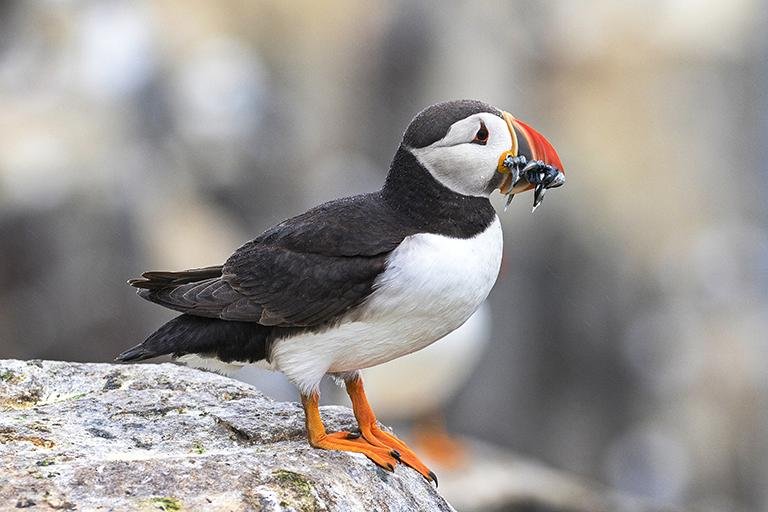
Farne Islands, Northumberland, UK
The impossibly cute and, as a result, popular Atlantic puffin spends summer on their breeding grounds in the Faroe Islands, Nova Scotia, Labrador, Newfoundland, Greenland, Norway, Iceland and the United Kingdom. It spends the remaining eight months of the year away from shore in the north and mid Atlantic Ocean ranging from the edge of the arctic ice as far south as the Mediterranean.
Feeding
Atlantic puffins are carniverous and eat small, schooling fish such as hake, herring, capelin and sand eels augmented with zooplankton, shrimps and other crustaceans and marine worms. They float on the surface and dive using wings and webbed feet to propel them to depths up to 200 feet. Their unique bills with special spines enable them to grip many fish simultaneously.
Breeding
Puffins are monogamous, probably for life. They nest in colonies which may number several thousand individuals. They prefer island sites which reduce risks from terrestrial predators. Couples share the excavation of burrows on the grassy edges of cliffs, in rocky crevices or under boulders. They line the nest with feathers, grass and any other soft material the pair can find. A single white egg is incubated by both parents who also share chick raising.
Wildfile Specials
- Puffin chicks are called pufflins
- When Atlantic puffin chicks have fledged, but before they are competent flyers, they leave the nesting colony at night and make their way to the shore negotiating perilous rocks and cliffs. They then paddle out to sea and do not return to land for up to 3 years.
- When in their burrows, Atlantic puffins communicate with a growling sound similar to a revving chain saw.
- Once they leave the colony after the breeding season, Atlantic puffins become solitary and spread out across the Atlantic ocean maybe staying within a few hundred mile of their base or maybe migrating for thousands of miles.
- [As with many other seabirds, Atlantic puffins have black backs and white undersides. Difficult to spot from above amidst the dark waters and from below through the bright sunlight, puffins are camouflaged for protection against both aerial and marine predators.
- There are two other species of puffin both found in the north-east Pacific Ocean: the tufted puffin and the horned puffin,. The latter is a close relative of the Atlantic puffin.
- Atlantic puffins are still eaten by people in Iceland and on the Faroe Islands.
- Due to rapid decline in numbers, the Atlantic puffin is classified as vulnerable by the IUCN. However, there is still a large population with a wide range and in some locations numbers have increased considerably due to conservation efforts.
- The Altantic puffiin's name in Latin is fratercula arctica which in English translates as "Arctic little friar". The little friar refers to the puffin's black and white plumage which resembles a friar's monastic robes..
- Puffins' large, colourful beaks have earned them the nicknames "clowns of the sea" and sea parrots.
- A number of countries and dependencies bordering the Atlantic have pictures of Atlantic puffins on their stamps. These include Canada, Norway, Iceland, Russia, France, the United Kingdom, Gibralter, Faroe Islands, Isle of Man, Jersey and St Pierre et Miquelon.
- Penguin books introduced Puffin Books for children in 1939 with the picture of an Atlantic puffin on the cover. Following huge demand, schools established Puffin Book Clubs to encourage reading. A children's magazine called Puffin Post followed.
- Puffin popularity makes them a lucrative tourist attraction to places such as the Farne Islands and Lundy Island. Much of the income enables the RSPB and the UK National Trust to enhance their conservation efforts in the interests of all marine species.